Showing posts with label Bible Plants. Show all posts

Monday, October 29, 2012

Wear them, Eat them as a laxative, Grow them...


People have sewn them together and worn them, eaten them as a laxative, and grown them for thousands of years. It’s named in the Tanakh, New Testament and Quran. King Solomon mentioned them around 940 B.C. and Charles Dicken’s in 1848 rewrote a proverb using it.

"Train up a fig tree in the way it should go, and when you are old sit under the shade of it." — Charles Dickens 

Anyone else growing Figs?

I’m a fig farmer — we’ll technically I’m currently only growing three fig trees. Since I live in the Hoosier Heartland, I am growing the hardy variety: Ficus carica “Hardy Chicago.”

My ‘Hardy Chicago’ Figs that grow in my “gotta’ be tough to survive Janet’s Hoosier Heartland Garden’ are doing well.  High-yielding and easy to grow, it produces delicious medium-size figs. They are drought-tolerant once established — and I unashamedly admit that I planted three in the late fall of 2011 and this summer only lost one. All three died back, as expected, during the winter and resumed fervent growth late in spring. But I noticed after a record-breaking severe drought where many Indiana counties were declared natural disasters and I couldn’t possibly water everything [my way of alleviating the guilt] that one of my little figs had succumbed by August. After all I did buy her (and her two brothers) at Lowes  on clearance for only $2.98 each.  I was so enthralled with my Fig Tree triplets (before the drought) that I bought a beautiful three-foot Chicago Fig from the Indianapolis Museum of Art Perenniel Premiere on April 21st. She is lovely and has produced nine gorgeous antioxidant-filled figs on her first summer at our home. She will be overwintering inside this winter — the other two will tough it out.

If I didn’t tell you already — the ‘Hardy Chicago’ Fig variety will die back in colder climates and resume growth in spring. They are heat-tolerant — well, 3 out of 4 are.  The figs ripens mid summer to late fall and are self-pollinating.

And in case you didn't make the connection, Eve sewed fig leaves together to make loin coverings (Genesis 3:7)
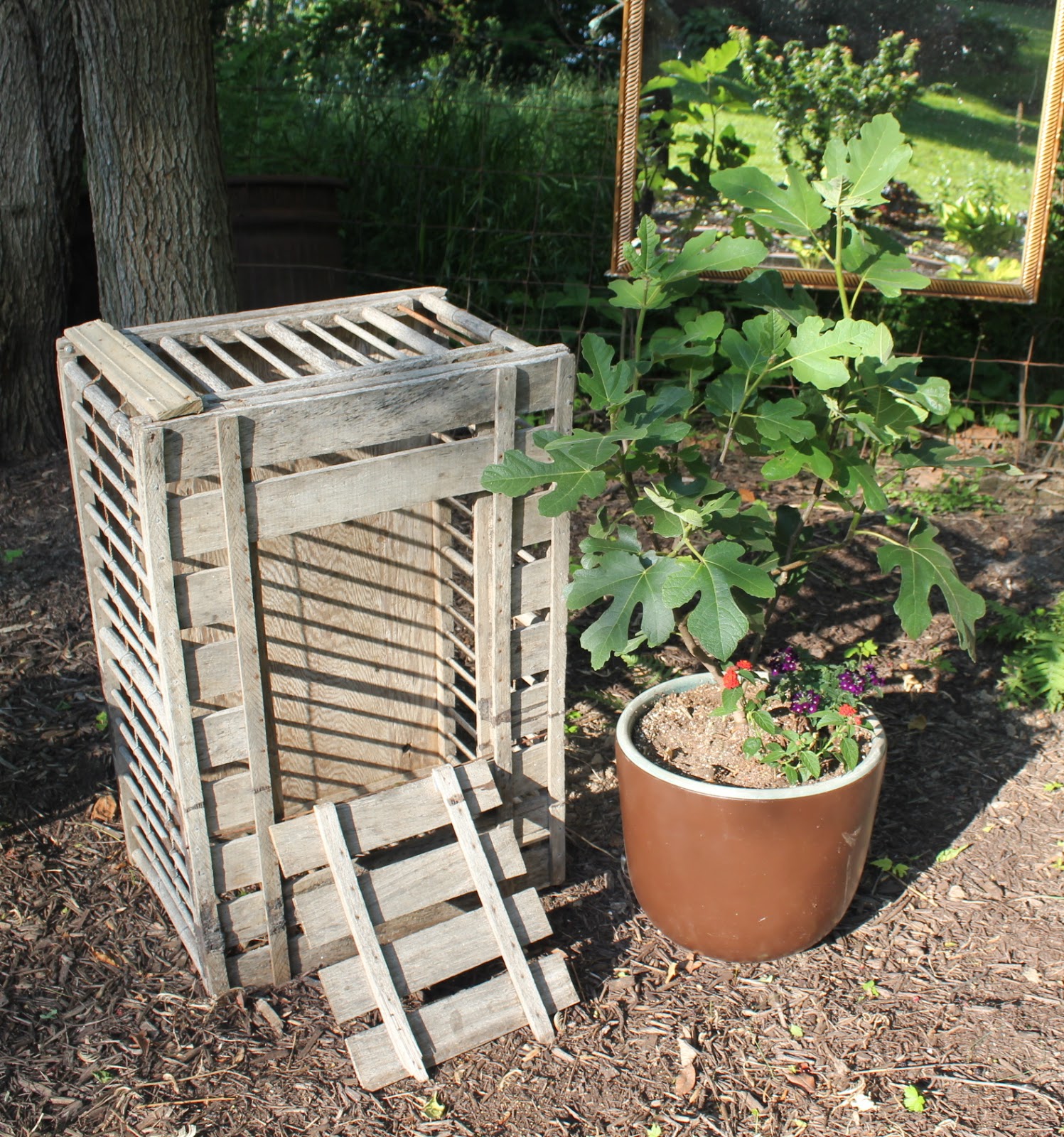
My potted Ficus carica 'Hardy Chicago' May 2012

Interesting article about the recent discovery and ongoing research of an elaborate ancient garden near Jerusalem which was home to a wide variety of exotic imported plants. — including the indigenous fig tree:

more on figs later...

Sunday, March 25, 2012

Love At First Smell...


I fell in love the first time I smelled her.

She caught my eye clothed in purple as she delicately swayed in the breeze — in rhythm to the jazz music playing at a garden party.

Now thirty years later she still stands out among the hundreds of others that have come courting my heart.

I love lavender.

Maybe it’s the bright purple color that towers over the fragrant, needle-like leaves. Maybe it’s her distinct musky aroma that beckons my love — and the hundreds of honeybees that are drawn to her like magnets.  I realize, of course, that I’m not her only lover.

Perhaps what intrigues me is that people like me have been using her as a remedy for ailments for thousands of years.  She can be used for cooking, as tea, essential oil or soaps and bath salts. The ancients use to call her spikenard or nard — I just refer to her as lavender.  She was used in ancient times by the Egyptians and people of Arabia for perfume and mummification, Romans employed lavender oils for cooking and bathing in addition to using the strong scent as a natural insecticide. In ancient Greece, lavender was called “nardus,” “nard,” or “spikenard”  — named for the Syrian city of Naarda.

Lately I’ve slept with a new lavender sachet near my pillow and understand first hand why this herb has been used for thousands of years as a remedy for sleeping ailments. The University of Maryland Medical Center recently noted: “Research has confirmed that lavender produces slight calming, soothing, and sedative effects when its scent is inhaled.”

Scientific evidence suggests that aromatherapy with lavender slows the activity of the nervous system, improves sleep quality, promotes relaxation, and lifts mood in people suffering from sleep disorders.   
According to Prevention, new research shows “Psychologists at Wesleyan University asked 31 men and women to sniff lavender essential oil one night--and then distilled water the next--for four 2-minute periods just before bedtime. The researchers monitored their sleep cycles with brain scans. On the night they whiffed the herb, subjects slept more soundly; they also felt more energetic the next morning.
 The researchers found that lavender increased slow-wave sleep, the very deep slumber in which the heartbeat slows and muscles relax. During this phase, the brain is thought to organize memory, as well.”

Lavandula augustifolia at Willowfield Lavender Farm in Mooresville, Indiana.
But as I admitted, I’m not lavender’s only lover.
The first written record of the healing power of lavender is attributed to the Greek military physician Dioscorides around 77 AD. Dioscorides, collected medicinal plants from around the Mediterranean and noted in that De Materia Medica that lavender, when taken internally relieved indigestion, headaches and sore throats. Externally, lavender could be used to clean wounds and burns or treat skin ailments

It is recorded that Horace offered to send Virgil a whole barrel of his best wine in exchange for a phial of nard.

Roman Elder, Pliny, in his Natural History, published in the first century AD, listed twelve species of nard, ranging from lavender stoechas and tuberous valerian to true nard —  and recorded that lavender was good for menstrual problems, stomach problems, kidney disorders, jaundice, insect bites, dropsy, and infections.

According to Bible Fragrances: “In the Old Testament, nard is referred to in the Song of Songs, as a symbol of the intimate nature of the Bride’s love. This is the point at which relations with her beloved are initiated. When the perfume of nard is named, the bride recognizes her beloved as such.”


Like I said — I fell in love the first time I smelled her.