Tuesday, November 13, 2012

Wisdom learned from my little 'ole fig tree — stick a fig in it!


Wisdom from my little ole’ fig tree?

People have sewn them together and worn them, eaten them as a laxative, and grown them for thousands of years. It’s named in the Tanakh, New Testament and Quran. King Solomon mentioned them around 940 B.C. and Charles Dicken’s in 1848 rewrote a proverb using it.

In my new adventure of being a fig farmer, I wanted to share what my figs taught me today.— (I am currently growing three Chicago Figs  in my Zone 5b Heartland Garden — Ficus carica “Hardy Chicago.”

Monday of this week, it was a beautiful 70˚F and gardening was blissful. Tuesday we got our first central Indiana snow. Although the snow melted on impact, I am doing research inside today.

Figs are the first tree mentioned in the Bible. They are also the most mentioned fruit —over 47 times. Figs represented peace and prosperity.


But in James chapter 3, he warns listeners how evil our tongues can be. James 3:7-8 notes that “every species species of beasts and birds, of reptiles and creatures of the sea, is tamed and has been tamed by the human race. But no one can tame the tongue; it is a restless evil and full of deadly poison. “

This was especially true during the 2012 Presidential Campaign as Americans chose sides.

James further explains by using analogies in (3:11 – 3:13):

…From the same mouth come both blessing and cursing. My brethren, these things ought not to be this way.

Does a fountain send out from the same opening both fresh and bitter water?

Can a fig tree, my brethren, produce olives, or a vine produce figs? Nor can salt water produce fresh.

Who among you is wise and understanding? Let him show by his good behavior his deeds in the gentleness of wisdom.

As Matthew Henry wrote around 1706: A truly wise man is a very knowing man: he will not set up for the reputation of being wise without laying in a good stock of knowledge; and he will not value himself merely upon knowing things, if he has not wisdom to make a right application and use of that knowledge. These two things must be put together to make up the account of true wisdom: who is wise, and endued with knowledge? Now where this is the happy case of any there will be these following things:—1. A good conversation. If we are wiser than others, this should be evidenced by the goodness of our conversation, not by the roughness or vanity of it. Words that inform, and heal, and do good, are the marks of wisdom; not those that look great, and do mischief, and are the occasions of evil, either in ourselves or others. 2. True wisdom may be known by its works. The conversation here does not refer only to words, but to the whole of men’s practice; therefore it is said, Let him show out of a good conversation his works. True wisdom does not lie in good notions or speculations so much as in good and useful actions. Not he who thinks well, or he who talks well, is in the sense of the scripture allowed to be wise, if he do not live and act well. 3. True wisdom may be known by the meekness of the spirit and temper: Let him show with meekness, etc. It is a great instance of wisdom prudently to bridle our own anger, and patiently to bear the anger of others. And as wisdom will evidence itself in meekness, so meekness will be a great friend to wisdom; for nothing hinders the regular apprehension, the solid judgment, and impartiality of thought, necessary to our acting wisely, so much as passion. When we are mild and calm, we are best able to hear reason, and best able to speak it. Wisdom produces meekness, and meekness increases wisdom.

So, in short, I learned from my figs, James and Matthew Henry:
Words that inform, and heal, and do good, are the marks of wisdom; not those that look great, and do mischief, and are the occasions of evil, either in ourselves or others. — Matthew Henry

Now, I just need to pop a fig in my mouth to temper my tongue every time I’m tempted to use words that look great, and do mischief and are the occasions of evil. And when I don’t have a mouthful of fig, to use words that inform, heal and do good — marks of wisdom.

Monday, October 29, 2012

Wear them, Eat them as a laxative, Grow them...


People have sewn them together and worn them, eaten them as a laxative, and grown them for thousands of years. It’s named in the Tanakh, New Testament and Quran. King Solomon mentioned them around 940 B.C. and Charles Dicken’s in 1848 rewrote a proverb using it.

"Train up a fig tree in the way it should go, and when you are old sit under the shade of it." — Charles Dickens 

Anyone else growing Figs?

I’m a fig farmer — we’ll technically I’m currently only growing three fig trees. Since I live in the Hoosier Heartland, I am growing the hardy variety: Ficus carica “Hardy Chicago.”

My ‘Hardy Chicago’ Figs that grow in my “gotta’ be tough to survive Janet’s Hoosier Heartland Garden’ are doing well.  High-yielding and easy to grow, it produces delicious medium-size figs. They are drought-tolerant once established — and I unashamedly admit that I planted three in the late fall of 2011 and this summer only lost one. All three died back, as expected, during the winter and resumed fervent growth late in spring. But I noticed after a record-breaking severe drought where many Indiana counties were declared natural disasters and I couldn’t possibly water everything [my way of alleviating the guilt] that one of my little figs had succumbed by August. After all I did buy her (and her two brothers) at Lowes  on clearance for only $2.98 each.  I was so enthralled with my Fig Tree triplets (before the drought) that I bought a beautiful three-foot Chicago Fig from the Indianapolis Museum of Art Perenniel Premiere on April 21st. She is lovely and has produced nine gorgeous antioxidant-filled figs on her first summer at our home. She will be overwintering inside this winter — the other two will tough it out.

If I didn’t tell you already — the ‘Hardy Chicago’ Fig variety will die back in colder climates and resume growth in spring. They are heat-tolerant — well, 3 out of 4 are.  The figs ripens mid summer to late fall and are self-pollinating.

And in case you didn't make the connection, Eve sewed fig leaves together to make loin coverings (Genesis 3:7)
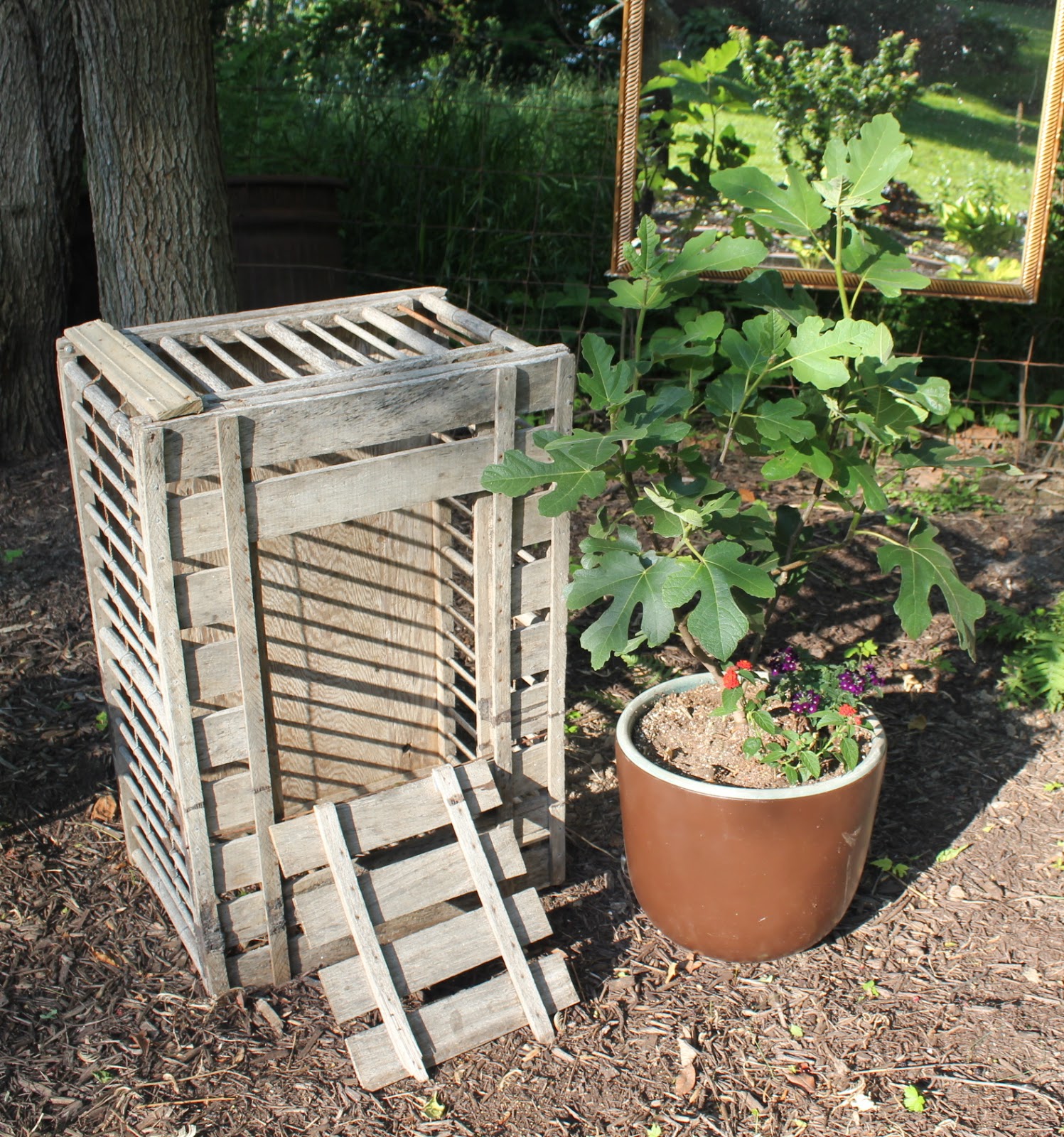
My potted Ficus carica 'Hardy Chicago' May 2012

Interesting article about the recent discovery and ongoing research of an elaborate ancient garden near Jerusalem which was home to a wide variety of exotic imported plants. — including the indigenous fig tree:

more on figs later...

Monday, June 25, 2012

Simply Cultivating . . . A Heartland Garden: When in Drought...

Simply Cultivating . . . A Heartland Garden: When in Drought...: 22 days, 7.5 hours, 8 minutes and 44 seconds When in Drought… Since we haven't seen a speck of moisture fall from the sky in about...

When in Drought...


22 days, 7.5 hours, 8 minutes and 44 seconds

When in Drought…

Since we haven't seen a speck of moisture fall from the sky in about 22 days, 7.5 hours, 8 minutes and 44 seconds (or something like that) I started thinking about droughts — probably a result of major dehydration from the extra hours of watering my new plant stock.

Naturally, I also began to think about the word 'doubt.'  When I later googled the phrase "When in doubt..."— I found a few answers: 

When in doubt — throw it out.
When in doubt — take more time.
When in doubt — mumble.
When in doubt — sing loud.
Benjamin Franklin said: When in doubt — don’t.
Oliver Wendell Holmes said: When in doubt — do it.

But how would you finish the phrase: When in drought?


When in drought  — ____________________________________________________.


A horrible sight...
What happens during a 90°F drought when you only water a hanging basket once a day.

Monday, June 18, 2012

Simply Cultivating . . . A Heartland Garden: A June visit to my Greenwood Indiana garden...

Simply Cultivating . . . A Heartland Garden: A June visit to my Greenwood Indiana garden...: Come into my garden and relax —  I hope you enjoy the colors and textures as much as I do. If you've neve...

A June visit to my Greenwood Indiana garden...

Come into my garden and relax — 

I hope you enjoy the colors and textures as much as I do.


If you've never experienced the joy of accomplishing more than you can imagine, 
plant a garden.  ~Robert Brault

Come back and visit y'all!


Sunday, June 10, 2012

A New Addition to my Garden. And what do you say? Yay or Nay?


My garden was missing something...

Last summer I installed (and by "I," I actually mean my husband) three mirrors as a backdrop to my Japanese Maple and hosta garden. The effect I was aiming for unequivocally did NOT work.

Mirrors removed.

Earlier this summer I (and yes, you know what "I" means) installed two panels of  a three sided dark cherry lattice backdrop ....it worked.

But my garden was still missing something.

Today, before church, my gardening partner and I went to our local Bargersville Flea Market. And although Steve had to talk me into it -- (He makes quick decisions and I like to plod in thought before I buy anything) we purchased a bronze 4-foot long Japanese outdoor lantern.

It took:

30- minutes to decide where it should hang.
60-minutes to lasso the rope over the correct tree limb.
90-minutes to chainsaw and trim tree limbs that were in the way.
60- minutes to drag the limbs to the fire/pit and compost pile.

....but spending time in the garden with my partner was priceless.

The next step is to find some solar or battery-operated lights to fill the inside of the lantern.

Do you think the lantern works?

Last summer during the drought, I put in a Japanese Maple/Hosta Garden.  Erroneously (because it looked dumb and didn't really work) I put in three mirrors (now removed) as a "backdrop" to this garden canvas. Today on a pre-church trip to the Bargersville Flea Market, my gardening partner and I spotted this bronze latticed Japanese-looking lantern. After a few attempts to lasso a rope over the correct tree limb, it now hangs in the garden awaiting candles or battery-operated lights. 

Another angle...and though it does look like we have a cow trough in our yard -- there is a fence separating our yard from the cow pasture next door. And yes, I will be jumping the fence soon to move the unused trough to another nearby location. 

I can't wait to install the lights and see what it looks like at night.